
Share

A Practical Guide for Banking, Insurance, and Wealth & Asset Management Firms

Salesforce Financial Services Cloud (FSC) delivers a unified, industry-specific data model and tailored workflows for bankers, advisors, and agents layered seamlessly on top of Sales and Service Cloud.

For banks, insurers, and wealth managers, FSC unlocks faster onboarding, deeper client relationships, enhanced compliance, and a future-proof foundation for AI; all while preserving your core systems and existing investments.

This guide breaks down what makes FSC a game-changer, outlines an ideal target architecture, highlights critical migration considerations, and offers a practical roadmap for implementation.

Why Migrate Now: Driving Business Value and Optimizing Total Cost of Ownership

Purpose-built for financial services​

Financial Services Cloud (FSC) extends the Salesforce core with industry-specific capabilities such as Relationship Builder, Action Plans, Life & Business Events, Interest Tags, and specialized sub-vertical models for Wealth/Asset Management, Mortgage, Retail Banking, and Commercial Banking. The result? Less customization, more out-of-the-box capability.

Lower technical debt, lower total cost of ownership​

Migrating from a heavily customized org to FSC allows organizations to retire bespoke objects and flows, standardize on an industry-grade data model, and free up team capacity to focus on innovation rather than maintenance.

Stay ahead with Salesforce’s innovation engine​

FSC is where Salesforce is investing most heavily. Moving now ensures you benefit from every new release without having to build these capabilities yourself, keeping your operations agile, scalable, and future-ready.

Treat migration as a data opportunity​

Beyond just moving systems, use this transition to enhance your insights. FSC’s built-in analytics enable advisors, agents, and bankers to prioritize actions and engage clients in real-time, turning data into actionable intelligence.

The Target Architecture: What a Modern FSC Stack Looks Like

  • FSC Core provides the foundation with relationship and household models, dedicated consoles for agents, bankers, and advisors, plus streamlined referrals and service workflows.
  • Data Cloud unifies client profiles across multiple systems, handling identity resolution, generating calculated insights, and enabling real-time segmentation.
  • Experience Cloud delivers branded, self-service portals for clients, brokers, and partners, supporting onboarding, document exchange, and service status tracking.
  • Agentforce brings embedded AI to call preparation, case triage, and underwriting, all with a human-in-the-loop approach and policy-guarded oversight.
  • nCino and Industry Apps cover specialized processes such as banking origination, insurance claims and policy management (e.g., Guidewire, Duck Creek), and wealth custodianship.
  • The Integration Layer leverages API-led connectivity via MuleSoft, OIC, or iPaaS, linking core banking systems, LOS, KYC/AML, document generation/e-signature platforms, and more.
  • Analytics is powered by CRM Analytics or Tableau, with optional zero-copy access to enterprise data lakes or warehouses for deeper insights.
  • Security & Compliance features include encryption, field audit trails, consent management, least-privilege access, and data classification, all supported by Salesforce Shield.

Migration Considerations: Key Points to Address Early

1. Org Strategy

When shaping your org strategy, two questions come up early:

  • Should you operate through a single org or multiple orgs? And,
  • How will regional compliance requirements influence that decision?

Equally important is reaching alignment on systems of record—whether for Party, Policy, Product, or Case. Establishing this clarity upfront helps avoid duplication, ensures consistency, and sets the foundation for scalable growth.

2. Data Model & Party 360

  • In banking, this typically covers person and business accounts, households, related parties such as signers or guarantors, and financial accounts with their associated exposures.
  • For insurance, the scope expands to include the customer or policyholder, policies with their periods and coverages, claims, producers, and agencies.
  • In the wealth domain, the focus shifts to clients and households, financial accounts and holdings, investment goals, and suitability profiles.

A key early decision is whether to enable Person Accounts. This choice drives how data is structured, so standardizing picklists and reference data upfront is crucial for long-term consistency. One important consideration: enabling Person Accounts affects both storage and record counts, as each Person Account equals one Account plus one Contact. Organizations should plan carefully for data volumes and downstream integrations to avoid scaling challenges later.
3. Identity, Dedupe & Data Cloud

  • Start by establishing golden keys, like Customer IDs or EINs, to uniquely identify records across systems.
  • Use a mix of deterministic and probabilistic matching to reconcile duplicates and define clear survivorship rules to determine which data should take precedence.
  • Next, create crosswalk tables to preserve legacy IDs, ensuring historical continuity and smooth system transitions.
  • Don’t wait to capture high-value relationship data—the earlier you start, the better your insights will be, because the quality of Financial Services Cloud insights directly depends on the quality of your data.

4. Integrations & Events

  • When integrating systems, it’s important to balance event-driven approaches for real-time updates with batch processes for nightly operations.
  • Design contract-first APIs and test them thoroughly, including error-handling and retry strategies, to ensure reliability.
  • As organizations adopt Financial Services Cloud’s new data model, such as Person Accounts, interfaces may need to be re-aligned to maintain data consistency.  
  • Finally, don’t forget to revalidate Named Credentials, Connected Apps, and downstream mappings to ensure seamless integration across all systems.

5. Automation & Reporting

  • Conduct a thorough review of legacy Flows, Apex code, and reports, and deprecate anything dependent on old data models to streamline your system.

6. Security & Privacy

  • Secure sensitive data by encrypting PHI/PII, enforcing row-level access based on role or region, and leveraging Shield for audit and compliance.
  • Plan data retention carefully, including external audit trails from legacy systems, to meet regulatory requirements.

7. User Training & Change Management

  • Build on existing Sales and Service Cloud knowledge while focusing training on key Financial Services Cloud differences, such as Financial Deals versus Opportunities and Interaction Summaries versus Tasks.
  • Develop a “What’s Changed” catalog to provide users with a quick, easy reference for the updates.

8. Licensing & Entitlements

  • Financial Services Cloud (FSC) includes core Sales and Service functionality out of the box
  • Optional add-ons such as nCino, Data Cloud, Digital Engagement, Field Service, and Knowledge can extend capabilities further.
  • Experience Cloud licenses are required for external users to access FSC features.

9. Performance & Limits

  • Adopt asynchronous patterns like Queueable and Platform Events to handle processing efficiently. Optimize automations for bulk operations and archive large historical data to maintain system performance.

10. Governance & Change Leadership

  • Map “day-in-the-life” changes for each persona to understand how updates impact daily workflows.
  • Engage stakeholders early and continuously to ensure alignment and smooth adoption
__wf_reserved_inherit

Final Word

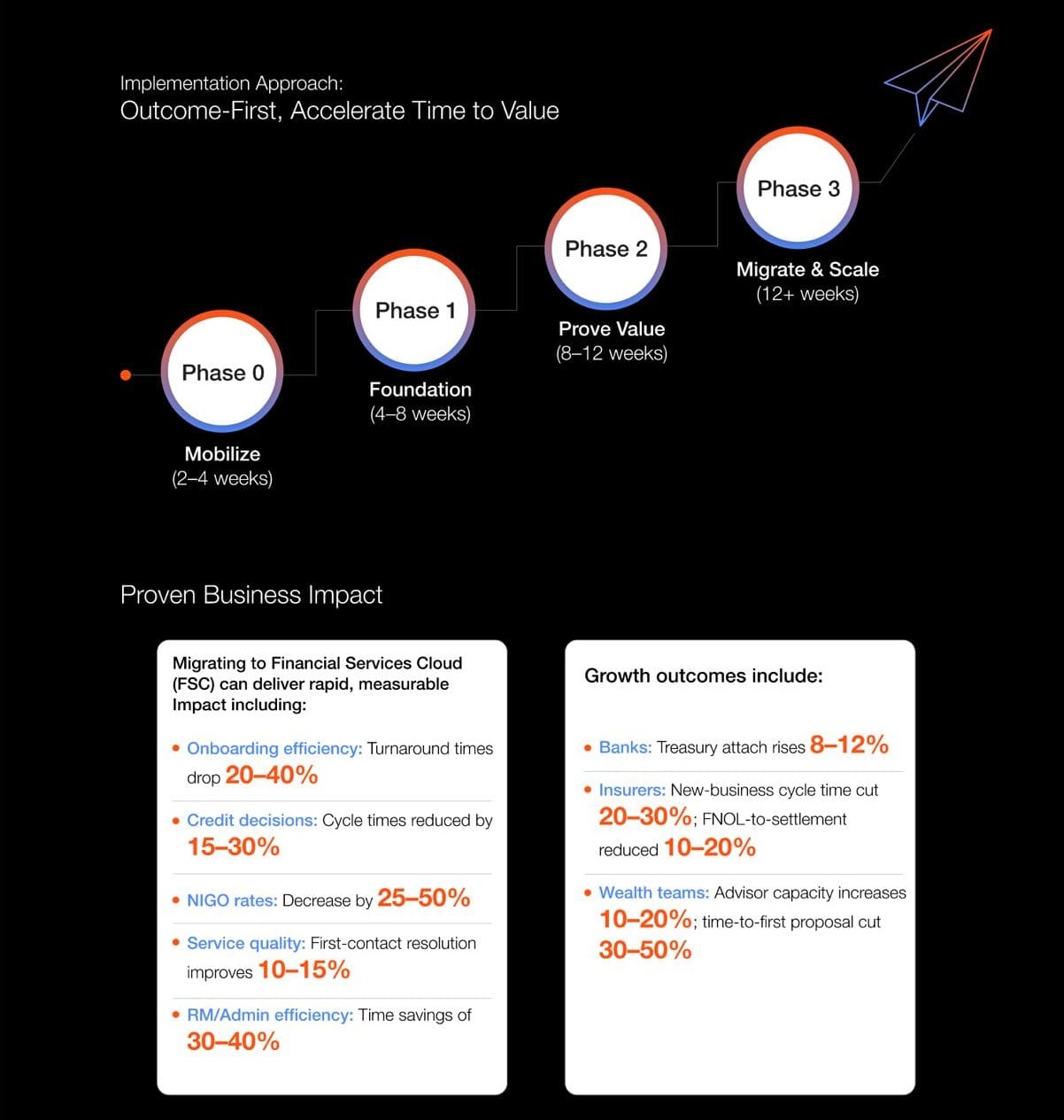
FSC is not just another CRM, it’s a modern, data-powered operating model for relationship-driven financial services across banking, insurance, and wealth. When paired with Data Cloud, Experience Cloud, and a disciplined migration factory, organizations can achieve measurable wins within a quarter, while setting the stage for AI-driven insights and sustained growth.

With Altimetrik, migrating to FSC is more than a transition, it’s a fast track to measurable impact, AI-readiness, and long-term growth. Let’s build your future-ready financial services platform together. Talk to our experts to start your FSC journey today!

‍

    ‍
More Industry Insights

Harnessing Altimetrik’s Expertise

From Reactive to Predictive_ A Guide to Governing Every Artifact Your Enterprise Runs
Blog

Agentic Regulatory Banking Workflows, Built to Ship: A Reference Architecture for Production-grade BFS Agents

Code generation got fast. Getting an autonomous workflow into a bank’s production control environment did not. In Banking & Financial Services (BFS), the blocker is rarely the model; it’s trust. A risk officer will not sign off on a system that cannot say why it flagged something, that does its arithmetic inside a language model, or that leaves no audit trail an examiner can open. That is exactly the gap most agentic pilots die in.
Over the last two quarters, we built a portfolio of ten BFS agentic offerings on Alti AIOS™, Altimetrik’s AI Operating System, and deployed them on two stacks: Google Cloud with Gemini and AWS with OpenAI. This piece is the architecture and design principle behind them.
Read More
Blog

From Evidence to Governed Execution: Unlocking Life Sciences Value with Snowflake and ALTi AIOS™ 

Here is something most life sciences organizations already know but rarely say out loud: Snowflake did its job. The data lake is full. Batch records, deviation logs, CAPA histories, COA repositories, clinical trial evidence, it is all there, unified, queryable, and beautifully governed. And yet the quality director is still chasing approvals through email threads. The compliance team is still manually cross-referencing batch records against specifications before a release decision. The CAPA cycle is still measured in weeks, not hours.

Data centralization was never the finish line. It was the foundation. The question now is whether that foundation does work or just sits there.

Read More

Contact Us

We'd love to hear from you.
Contact Us