A different approach to security modernization: prevent what you can, prioritize what matters, automate what makes sense, and prove continuously that your controls are working.
Ask any CISO how the vulnerability program is going, and you’ll get the same answer: ‘We’re making progress.’
Tickets are closing. Patches are shipping. The dashboard is green. And still, the backlog keeps growing. Audits keep finding gaps, and security teams keep running hard without ever feeling like they’re catching up.
We’ve seen this pattern enough times to know that capacity alone isn’t the answer. The operating model itself needs attention.
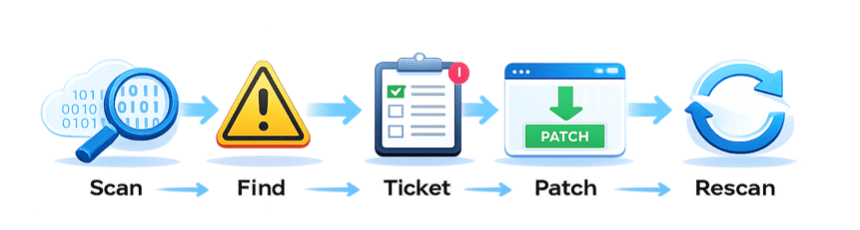
Traditional vulnerability management programs follow a familiar loop: scan the environment, find vulnerabilities, open tickets, patch them, scan again. Enterprises have spent years making every part of that loop faster and better.
But the environment that loop was built to protect has changed dramatically.
Today’s enterprise state extends across multiple clouds, code repositories, open source and third-party dependencies, container images, infrastructure that spins up and disappears in minutes, and now AI models and workloads on top of all of it. Vulnerabilities creep in through open-source packages, base images, build pipelines and software supply chains long before an application ever reaches production.
And yet the traditional operating model still waits for a scanner to identify a vulnerability before it acts.
Patching is reactive by design.
We still need to patch, and patch well. But getting better at patching can’t be the whole strategy. We also need to prevent more vulnerability debt from entering the estate in the first place – and get much sharper about which risks actually deserve attention.
We Need to Change The Loop
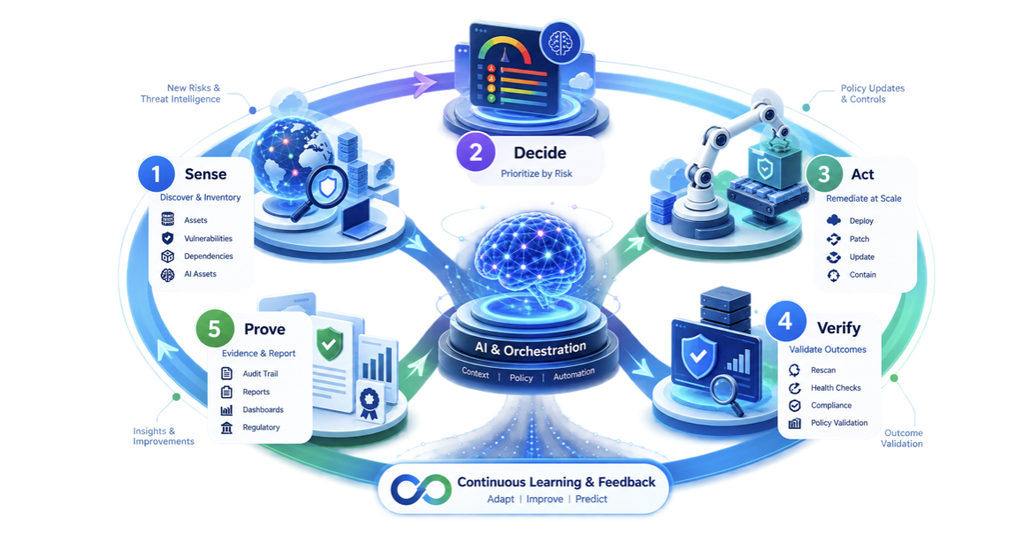
The traditional loop is linear and reactive: scan → ticket → patch → repeat. The continuous learning model closes that loop — signals from validation feed back into prevention, so the system gets smarter with every cycle rather than starting over.
The problem isn’t really any single one of those steps. It’s what happens, or doesn’t happen, between them.
Security knows about vulnerabilities. Infrastructure knows about assets. Application teams understand the business context. The CMDB holds it’s own view of the environment. Patch platforms understand deployment state and policy. CI/CD knows what’s about to enter production.
The problem is that these signals rarely come together in one place, at the right time, to inform the next decision.
That’s why we think the more useful model looks like this:
This changes the goal.
Instead of optimizing each security activity on its own, the goal is to run a closed loop: continuously understand the estate, decide what matters, act within clear boundaries, verify the outcome, and turn what we learn back into intelligence for the next decision.
We apply that thinking across five areas:
Discover and Inventory — Maintain continuous visibility across assets, dependencies, vulnerabilities and emerging AI assets.
Prevent at the Source — Harden images, govern third-party software and enforce controls upstream to reduce vulnerability debt ever before it enters the environment.
Prioritize by Risk — Weigh signals like exploitability, EPSS, known exploitation, asset exposure and business criticality together, so effort goes where it actually matters.
Remediate at Scale — Identify trusted remediation, validate it, and deploy it across large environments, with automation and agents doing the heavy lifting where it makes sense.
Validate and Prove — Confirm the fix worked, capture what we have learned, and feed that intelligence back into the lifecycle so every outcome improves the next decision.
Prevention isn’t really one step in that sequence, it cuts across the entire lifecycle. Every vulnerability we prevent upstream is one less vulnerability that has to be discovered, prioritized and remediated later.
Working with large enterprises, the same handful of problems keep showing up.
Vulnerability Intelligence and Risk Prioritization
Most enterprises don’t lack vulnerability data. What they lack is context. Bring scanner telemetry, asset data, exposure, exploitability and business criticality together, and the question changes from ‘What vulnerabilities do we have?’ to ‘What’s actually risky, and what do we do about it?’
Software Supply Chain Governance
A lot of vulnerability debt gets in before production even starts, through open-source packages, base images and dependencies nobody’s really governing. Push controls upstream — trusted repositories, SBOMs, software composition analysis, hardened images — and that debt never enters the estate in the first place.
Trusted Third-Party Remediation
When something needs fixing fast, finding the patch can become its own supply-chain risk. Instead of every team hunting for fixes on their own, agents can identify trusted remediation sources and candidate fixes, then bring them into a controlled pipeline for validation before anything goes internal. The result: one governed remediation supply chain instead of hundreds of teams sourcing patches independently.
Continuous Golden Image Engineering
Golden images are one of the best preventative controls we have, but too often their upkeep is manual and occasional. Build scanning, remediation and policy validation into the pipeline itself, and the image stays continuously hardened and governed, not just refreshed on patch day.
Continuous Security Compliance
A security policy only matters if it’s consistently enforced. Agents can help translate requirements and organizational context into policy-as-code, while deterministic controls validate compliance and people keep authority over the decisions that matter. Evidence becomes part of how you build, not something you scramble to reconstruct before an audit.
AI Asset Governance and Agent Assurance
AI adoption is moving faster than governance can keep up. Enterprises need visibility into their models, RAG pipelines and agents, but knowing they exist isn’t enough. As agents gain more autonomy and tool access, what they’re actually allowed to do should drive testing, runtime controls, human oversight and ongoing assurance.
The Architecture Matters More Than the Tools
The common thread across all of these areas is that most enterprises don’t need another security platform. They’ve already invested in scanners, endpoint platforms, ITSM, cloud security, artifact repositories, CI/CD, SIEM and observability.
The bigger opportunity is connecting what’s already there.
Use agents where reasoning genuinely improves a decision or action. Use deterministic automation where outcomes need to be predictable. Let existing tools keep doing what they already do well. Set clear policy boundaries, and keep people in control where judgment and accountability matter.
That is the architecture we think security modernization increasingly needs: vendor-agnostic, orchestration-led and built around the estate you already have.
Security Should Produce Evidence, Not Activity
We don’t think a security program should be judged by how many vulnerabilities it found, tickets it opened or patches it deployed.
Those are measures of activity.
The better question is simpler: are we continuously reducing exposure, and can we prove our controls are working?
Prevention reduces what enters the estate. Discovery tells us what’s there. Risk intelligence tells us what matters. Remediation closes the exposure. Validation tells us whether it actually worked.
And the evidence created along the way gives security teams, auditors, regulators, customers and boards something they rarely get from the same system: a shared view of control.
That’s the shift we’re working toward:
From finding and patching vulnerabilities to continuously preventing, prioritizing, remediating, validating and proving control.
What We’re Seeing in the Field
None of this is theoretical. We’re applying these patterns today with some of the world’s largest enterprises, across complex, multi-cloud environments.
Every organization starts somewhere different. For some, it’s third-party vulnerability remediation. For others, it’s software supply chain governance, image security or continuous compliance. Increasingly, it’s figuring out where AI models and agents fit into an already complicated security landscape.
We don’t think the answer starts with another platform.
It starts with understanding where your current security lifecycle is breaking down, what investments are already in place, and where better context, engineering, automation or agents can make a real difference.
If you’re dealing with any of these challenges, we’d welcome the chance to understand your landscape, share what we’re learning from the field and explore where we might help.Tell us where your security lifecycle is breaking down – that’s where we start.
The industry patches.We prevent — and prove.
Altimetrik | AI Engineering – Security Modernization
Author Bio
Author Bio
FR
Farid Roshan
Chief Digital and AI Engineering Officer, Altimetrik.
Farid Roshan is the Chief Digital and AI Engineering Officer, Altimetrik. where he leads the strategy and delivery of generative AI solutions across enterprise clients worldwide. He specializes in bringing together engineering expertise, governance, and compliance frameworks to deliver trusted enterprise outcomes through AWS-powered AI capabilities and responsible AI deployment.