
Blog
What the SR 2026 Delay Actually Means for Your ISO 20022 Roadmap
Swift’s SR 2026 delay changes the ISO 20022 roadmap. Learn what banks need to do now on structured addresses, compliance, data quality and migration.
Read More

In an era of Artificial Intelligence, Generative AI (GenAI) has gained massive popularity in the industry. The below image (image1) shows exposure of GenAI in various domains.
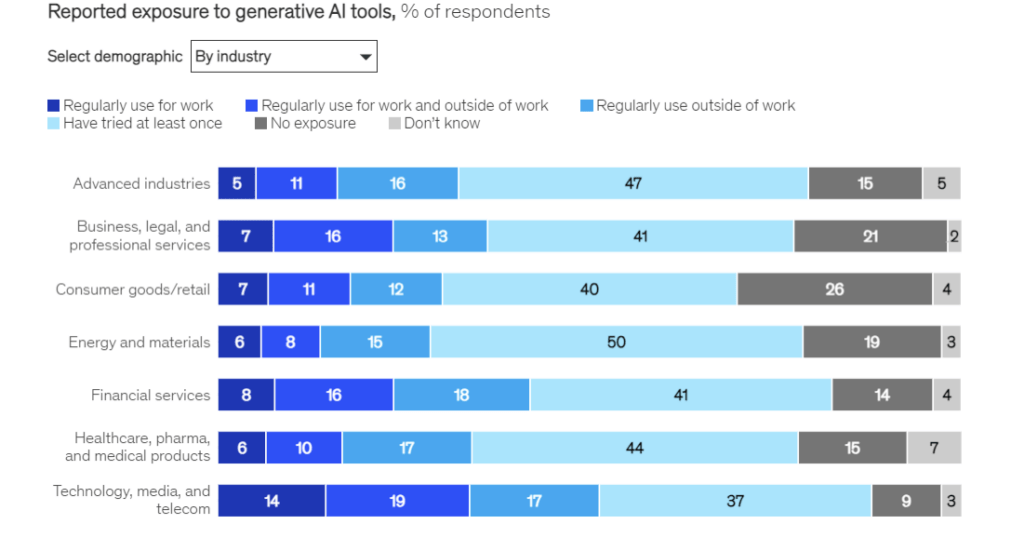
Image 1 – Exposure of GenAI per McKinsey^^
But, even after having so much popularity, McKinsey study^^ shows only 24% respondents use GenAI tools for their work in fintech industry. As per general belief, incorporating GenAI is often considered straightforward, so what obstacles do companies face in using it effectively?
To comprehend why companies are struggling to harness GenAI’s potential effectively, let’s delve into a simple example – Q&A Chatbot. Our objective is to develop an intelligent Q&A chatbot for the needs of a financial company –
Q&A Chatbot
Now, the question is – can we simply use the LLM (Large Language Model) as-is for querying and retrieving answers? The answer would be NO. These Large Language Models are trained with huge publicly accessible data, potentially leaving them devoid of organization-specific i.e., local context. The Below example (image 2) demonstrates how GenAI model lacks local knowledge.

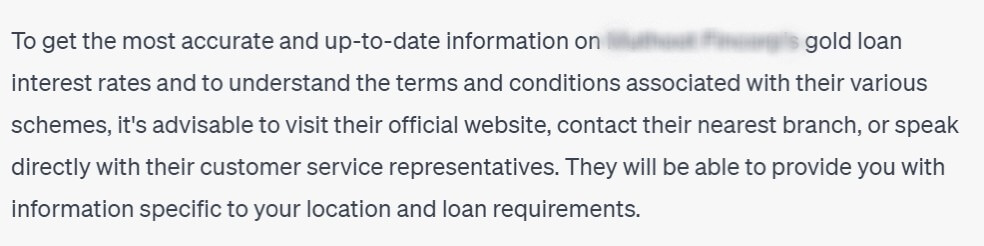
Image 2 – ChatGPT snapshot
Can we effectively engineer the prompt? Answer – Effective prompt engineering might solve about 20% of the problem, still major part of the problem will be left unsolved
Can we finetune with company specific data? Answer- Yes but acquiring thousands of quality data points is challenging for most companies. Even if they obtain such data, converting it into a usable format and fine-tuning it requires significant effort and resources, with potential improvements being marginal.
A more meaningful approach possibly involves generating embeddings and establishing an index of business-related documents. While this may address a portion of the issue, it’s still not perfect as it lags in keeping up with the most recent information (image 3).

image 3 – Experimentation with GenAI model to access latest information
Using none of the above approaches, we can offer relevant product suggestions, detect fraud etc. So, what is the underlying issue that companies seem to be overlooking or misunderstanding?
GenAI as a tool rather than a comprehensive solution
People have unrealistic expectations from GenAI. It’s important to understand that GenAI serves as a component to enrich a dish, rather than being the dish itself. LLMs exhibit impressive skills in emulating human-like text production but lack current information, organization specific (local) context, or even tasks where basic mathematics is required etc.
Having understood the challenges associated with GenAI, let’s now explore effective strategies for leveraging it to address our specific concern related to chatbot –

image 5 – Usage of agent to retrieve latest information
GenAI, with its inherent limitations, can’t handle every task on its own; therefore, supplementing it with external support can lead to remarkable outcomes. It should serve as a productivity-enhancing tool rather than being considered a standalone solution.
To sum up, Generative AI stands as a remarkable catalyst for both present and future technological advancements, but it’s true efficacy lies in its appropriate application. If used in the right way GenAI has the potential to enhance business decision-making processes, leading to increased efficiency and cost reduction. To become unstoppable, business must uniquely incorporate GenAI and automation into their business strategy. The way Business incorporates GenAI into their business strategy will ultimately dictate their survival or success.
Swift’s SR 2026 delay changes the ISO 20022 roadmap. Learn what banks need to do now on structured addresses, compliance, data quality and migration.

Code generation got fast. Getting an autonomous workflow into a bank’s production control environment did not. In Banking & Financial Services (BFS), the blocker is rarely the model; it’s trust. A risk officer will not sign off on a system that cannot say why it flagged something, that does its arithmetic inside a language model, or that leaves no audit trail an examiner can open. That is exactly the gap most agentic pilots die in.
Over the last two quarters, we built a portfolio of ten BFS agentic offerings on Alti AIOS™, Altimetrik’s AI Operating System, and deployed them on two stacks: Google Cloud with Gemini and AWS with OpenAI. This piece is the architecture and design principle behind them.
Here is something most life sciences organizations already know but rarely say out loud: Snowflake did its job. The data lake is full. Batch records, deviation logs, CAPA histories, COA repositories, clinical trial evidence, it is all there, unified, queryable, and beautifully governed. And yet the quality director is still chasing approvals through email threads. The compliance team is still manually cross-referencing batch records against specifications before a release decision. The CAPA cycle is still measured in weeks, not hours.
Data centralization was never the finish line. It was the foundation. The question now is whether that foundation does work or just sits there.
