GPT – Going beyond the chatbots: 5 key aspects everyone should know
Share
Empowering NLP with Generative Pre-trained Transformer
GPT or “Generative Pre-trained Transformer” has emerged as a cutting-edge artificial intelligence model that is revolutionizing natural language processing. With its advanced architecture, GPT can generate highly coherent and meaningful text that closely mirrors the original data in terms of style and content.
One of the key advantages of GPT is its ability to process long sequences of text, thanks to its transformer architecture. Additionally, GPT has been pre-trained on a vast corpus of text data, allowing it to recognize and understand the underlying patterns and structures of language.
As a result, GPT has a wide range of applications across various industries. It can be used for language translation, content creation, chatbots, text analysis, and more. For instance, GPT-based chatbots can communicate with customers more efficiently, while GPT-generated content can be used to create articles, blog posts, and product descriptions with greater ease.
The 5 Key Aspects of GPT You Need to Know
1. Unsupervised Learning
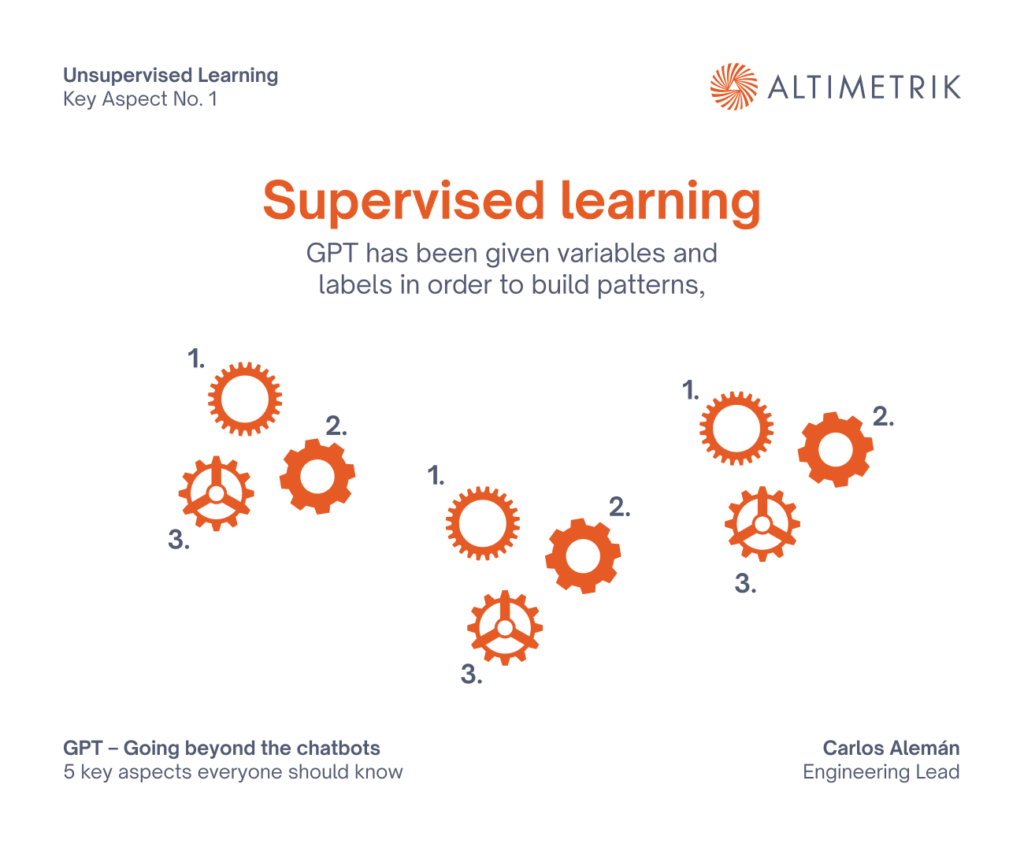
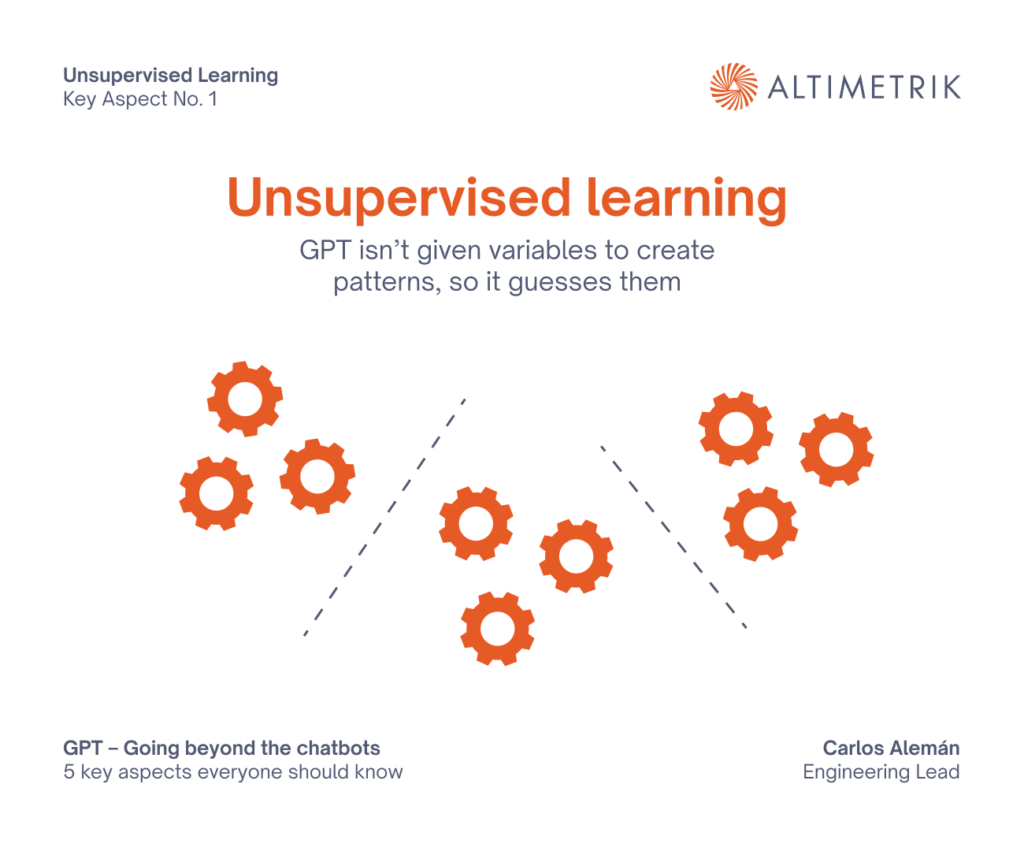
Unsupervised learning is a type of machine learning where a model is trained on a dataset without any explicit supervision or guidance. In the context of GPT, this means that the model is trained on massive amounts of text data without any specific task or objective in mind, using self-supervised learning to capture complex patterns and relationships in the language data. The benefit of unsupervised learning is that it allows the model to learn from a vast amount of data without the need for annotations or labels, making it highly flexible and adaptable to different tasks and domains. GPT’s unsupervised learning also allows it to generalize well to new tasks and domains, making it a powerful tool for natural language generation and understanding.
2. Natural Language Generation
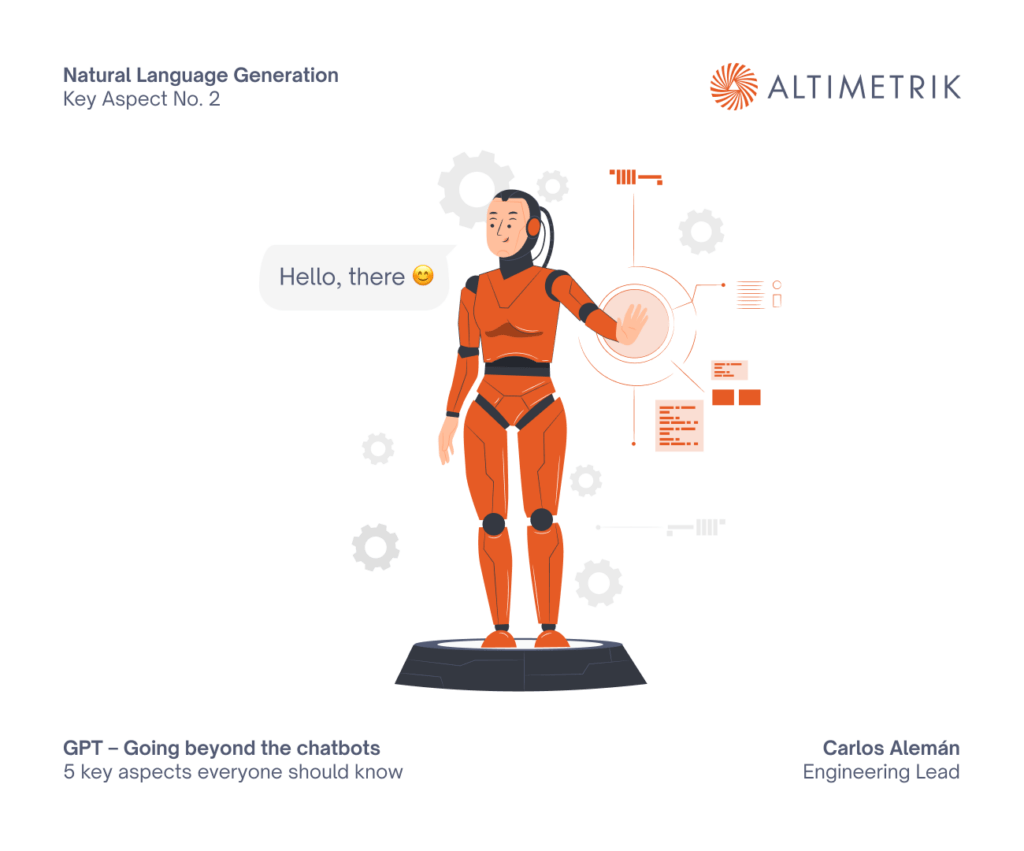
GPT has several different applications, being the most common ones chatbots, translations, virtual assistants, and automated writing, this is possible as it was properly designed to generate natural language text with highly coherency. GPT is designed for NLG, which means that it uses AI to generate human-like language. NLG is one of GPT’s key capabilities as it can generate text that resembles natural language through its ability to capture complex patterns and relationships in language data through unsupervised learning; these capabilities have the potential to transform many industries and applications that rely on natural language processing.
3. Large-Scale pre-training
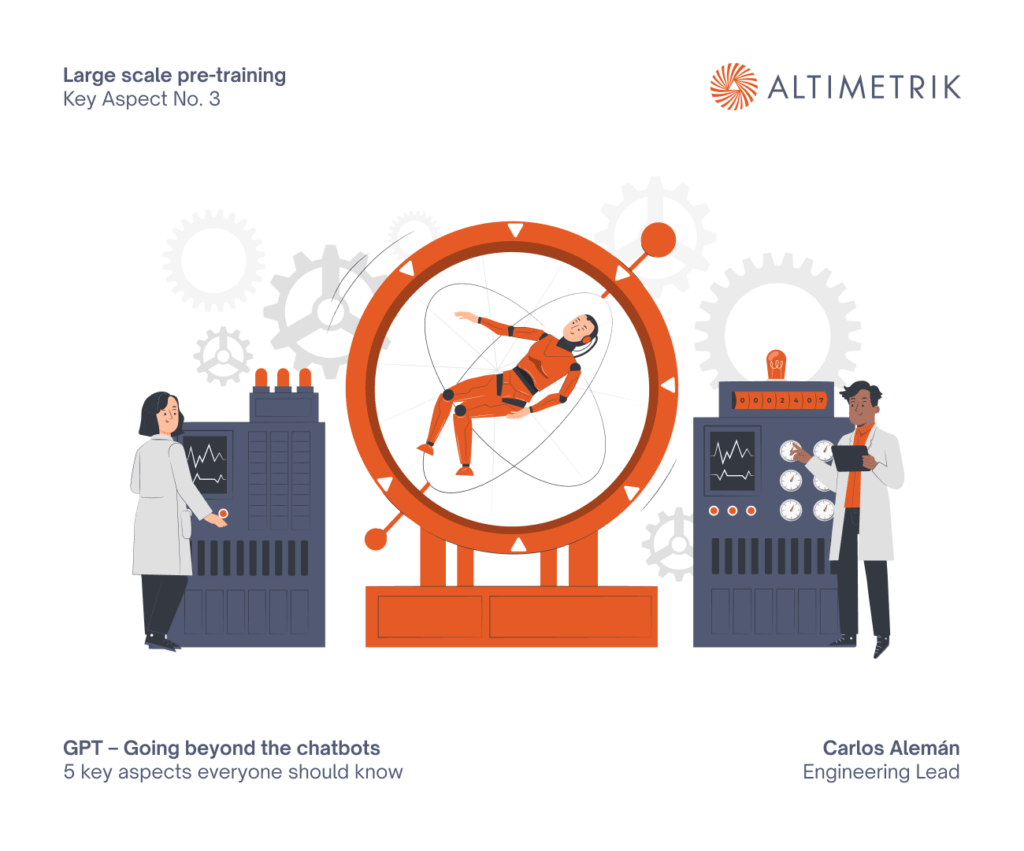
GPT’s large-scale pre-training involves training the model on massive amounts of text data using unsupervised learning, allowing it to capture the general patterns of language. This makes it highly flexible and adaptable to specific tasks through fine-tuning. Pre-training on a large scale also enables the model to learn from diverse sources, enhancing its ability to generate coherent and relevant language. Ultimately, large-scale pre-training is a critical aspect of GPT’s success, allowing it to capture the complex patterns and relationships in language and making it highly effective across a wide range of applications.
4. Transfer Learning
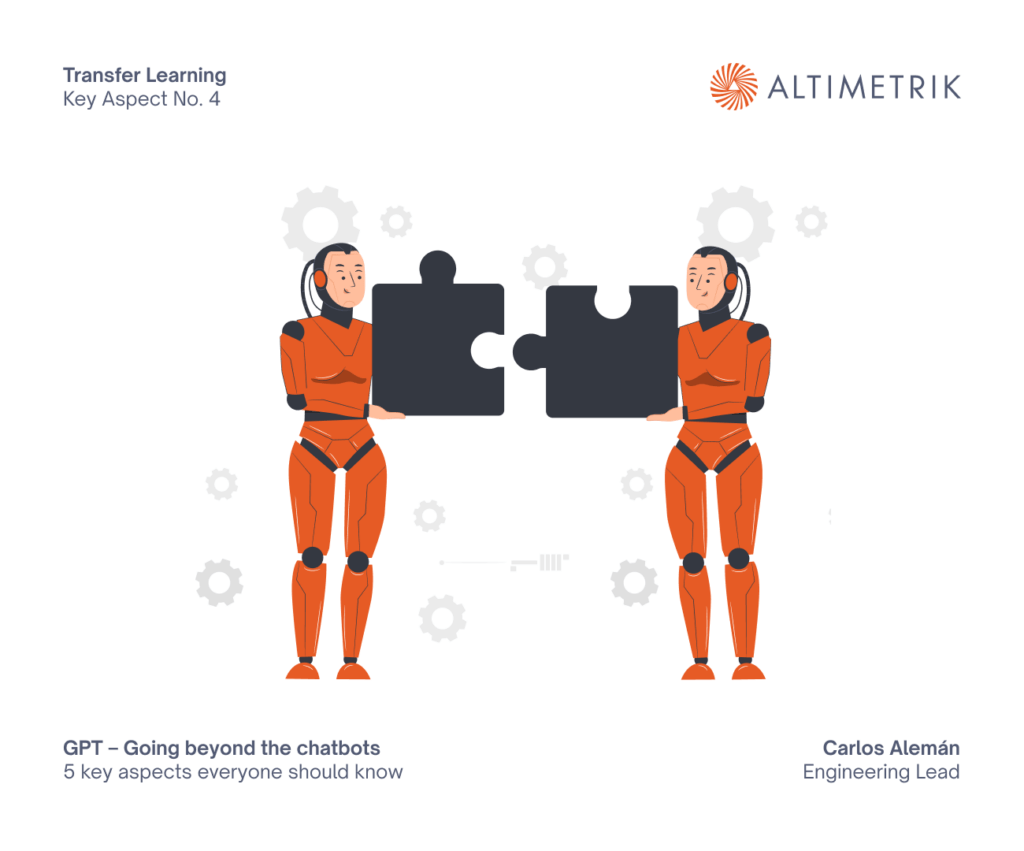
Transfer learning is a machine learning technique that involves using knowledge gained from one task to improve the performance of another task. In the context of GPT, transfer learning works by fine-tuning the pre-trained model on a specific task, which allows GPT to transfer its knowledge from pre-training to the new task and achieve state-of-the-art performance. GPT’s transfer learning capabilities are highly efficient, saving time and resources, and can be applied to a wide range of natural language processing tasks without additional training.
5. State-of-the-Art Performance
GPT’s state-of-the-art performance refers to the highest level of performance achieved on a particular task using the most advanced techniques available. This performance has been achieved due to GPT’s large-scale pre-training, which enables it to capture complex patterns and relationships in language, and its transfer learning capabilities, allowing it to efficiently apply what it has learned from one task to another, improving its performance. GPT has demonstrated state-of-the-art performance in various natural language processing benchmarks and competitions, with practical applications in fields like healthcare, finance, and education. Overall, GPT’s state-of-the-art performance demonstrates its advanced capabilities and potential to revolutionize various industries.
The practical applications of GPT are immense, and its impact on the future of AI is significant. As GPT continues to evolve and improve, it holds the potential to transform the way we interact with machines and consume content.
With its ability to generate highly accurate and meaningful text, GPT is paving the way for a new era of AI-powered communication and content creation. As such, GPT represents a major milestone in the development of AI technology and is poised to shape the future of human-machine interactions in the years to come.
In conclusion, it is evident that GPT is a significant milestone in the development of AI technology, and its impact on the future of human-machine interactions is poised to be transformative.
GPT’s ability to generate highly accurate and relevant language is paving the way for a new era of AI-powered communication and content creation, enabling machines to interact with humans in a more natural and intuitive manner. As GPT continues to evolve and improve, it holds the potential to revolutionize industries, enhance productivity, and augment our daily lives in ways we have yet to imagine.